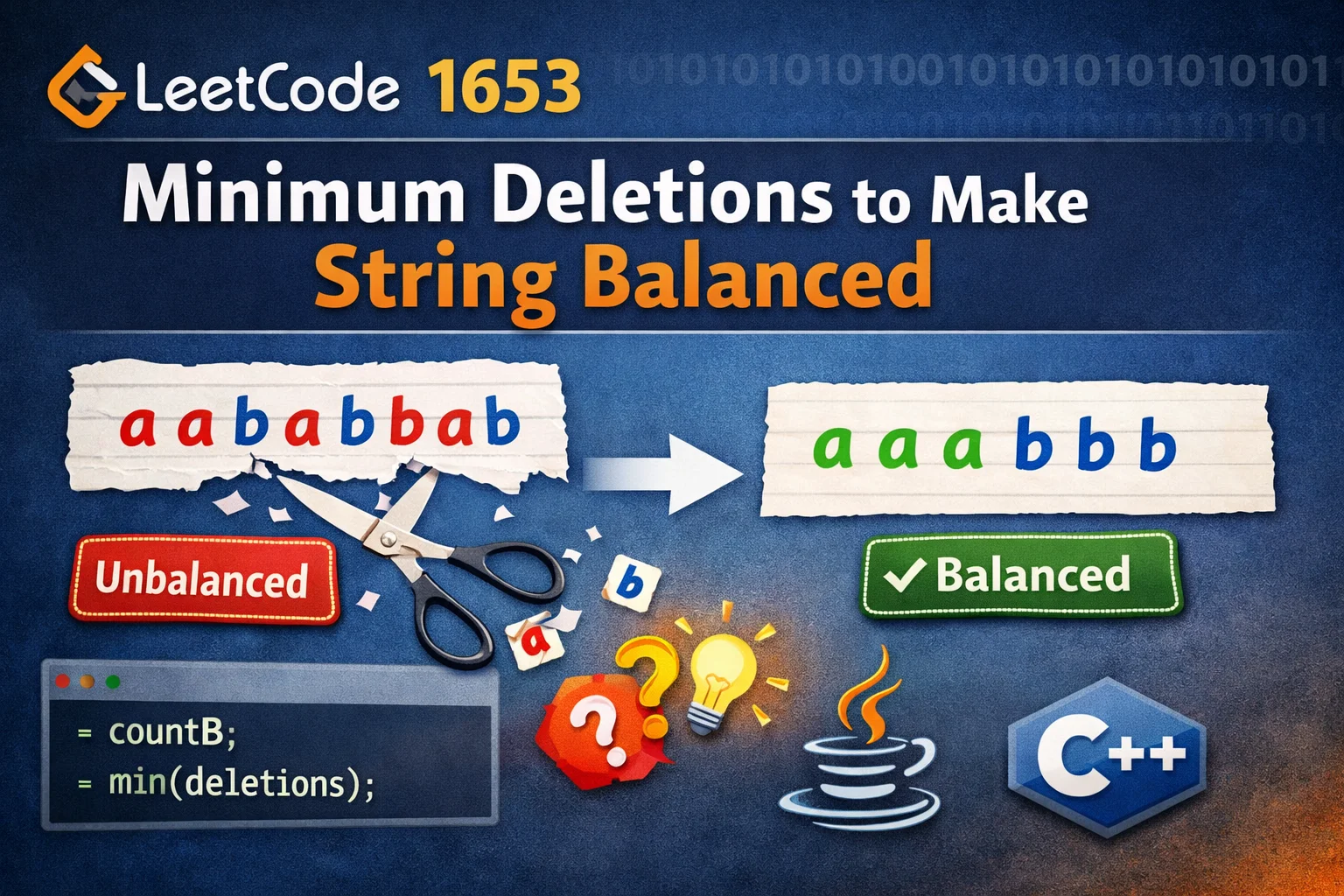
If you’re doing your LeetCode daily streak and today you hit Question 1653 — “Minimum Deletions to Make String Balanced”, this one is all about turning a messy mix of a and b into a “clean” order with the fewest deletions.
Let’s break it down like a human would, not like a textbook.
What does “balanced” mean?
You’re given a string s containing only:
ab
A string is balanced if all a characters come before any b characters.
So these are balanced ✅:
"aaaa""aaabbb""bbb"(yes — noaafterb, so it’s fine)
These are NOT balanced ❌:
"ba"(because there’s abbefore ana)"aababbab"(becauseaappears after someb)
Another way to remember it:
A string is balanced if it has no
"ba"pattern.
Goal
Delete the minimum number of characters (any positions you want) so the final string becomes balanced.
Quick examples
Example 1
Input: s = "aababbab"
Output: 2
You can delete 2 characters to make something like "aaabbb".
Example 2
Input: s = "bbaaaaabb"
Output: 2
Delete two b’s at the start (or some a’s in the middle), and it becomes balanced.
Key insight (the “aha” moment)
While scanning the string from left to right:
- Every time you see a
b, it’s fine —bcan sit on the right side of a balanced string. - Every time you see an
aafter you’ve already seen someb’s, you have a conflict (a"ba"situation).
When that happens, you have only two logical choices:
- Delete this
a
→ cost:deletions + 1 - Delete all previous
b’s (so thisais no longer “after a b”)
→ cost:countB(number ofbseen so far)
So at every problematic a, we choose the cheaper option:
deletions = min(deletions + 1, countB)
That’s the whole solution.
One-pass Greedy/DP Approach (Best for Interviews)
What we track
countB: how manyb’s we’ve seen so fardeletions: minimum deletions needed up to the current position
Step-by-step logic
For each character:
- If it’s
'b':countB += 1 - If it’s
'a':deletions = min(deletions + 1, countB)
This works because we’re always keeping the best possible answer for the prefix we’ve processed.
Time and space complexity
- Time:
O(n)(single pass) - Space:
O(1)(constant extra memory)
Perfect for large inputs.
Clean code solutions
✅ Python (LeetCode-ready)
class Solution:
    def minimumDeletions(self, s: str) -> int:
        countB = 0
        deletions = 0

        for ch in s:
            if ch == 'b':
                countB += 1
            else:  # ch == 'a'
                deletions = min(deletions + 1, countB)

        return deletions
✅ Java
class Solution {
    public int minimumDeletions(String s) {
        int countB = 0;
        int deletions = 0;

        for (int i = 0; i < s.length(); i++) {
            char ch = s.charAt(i);
            if (ch == 'b') {
                countB++;
            } else { // 'a'
                deletions = Math.min(deletions + 1, countB);
            }
        }
        return deletions;
    }
}
✅ C++
class Solution {
public:
    int minimumDeletions(string s) {
        int countB = 0;
        int deletions = 0;

        for (char ch : s) {
            if (ch == 'b') {
                countB++;
            } else { // 'a'
                deletions = min(deletions + 1, countB);
            }
        }
        return deletions;
    }
};
Mini walkthrough (to make it stick)
Take: s = "ba"
- Start:
countB=0, deletions=0 - See
'b'→countB=1 - See
'a'→ conflict:- delete
'a'→deletions + 1 = 1 - delete previous
'b'→countB = 1 - choose min →
deletions = 1
- delete
Answer: 1 ✅
Common mistakes people make
- Thinking you need to “rebuild the string” — you don’t.
- Using nested loops (goes
O(n²)and can TLE). - Confusing the balanced condition (it’s all
abeforeb, not the other way around).
FAQ
Is this dynamic programming or greedy?
It’s basically DP compressed into two variables. The update rule is DP-like, but it behaves greedily because we always choose the cheapest fix at each step.
Why is "bbb" balanced even with no a?
Because the rule is only: no a should appear after a b. If there are no a’s, nothing violates that.
Can I solve it with prefix/suffix counts?
Yes. You can compute:
- prefix count of
b - suffix count of
a
and try every split. It’s stillO(n)but uses extra arrays unless optimized.