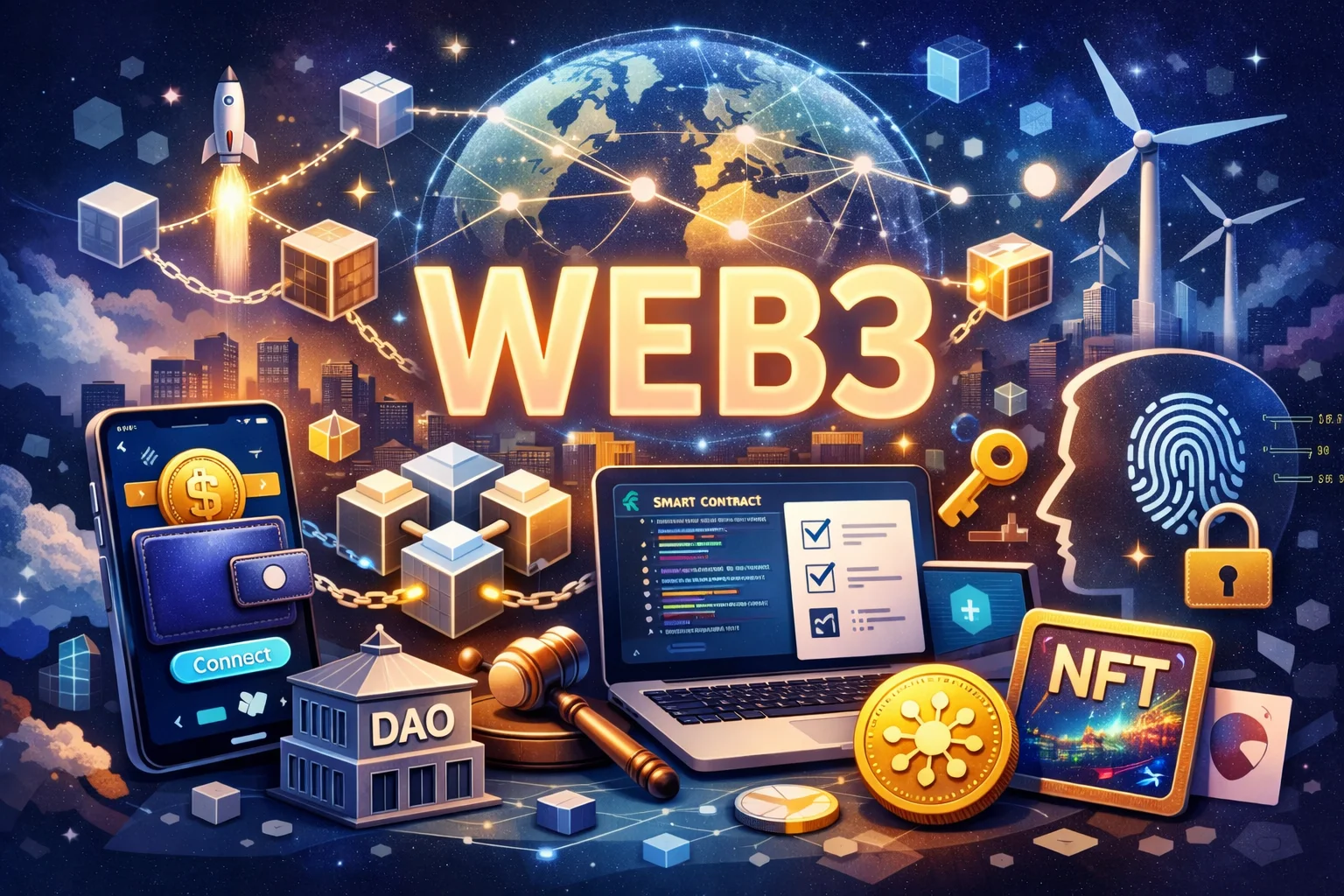
For decades, the internet has been a place where we do things—read news, post photos, stream music, run businesses. But despite how open the web feels, most of what we do online happens inside platforms that control the rules: who can participate, what content gets promoted, how creators get paid, and what happens to our data if policies change.
Web3 is an attempt to redesign parts of the internet so that ownership and control don’t sit primarily with centralized intermediaries. Instead, Web3 systems use blockchains and cryptographic tools to let users hold assets, identity-like credentials, and permissions directly—often without needing to ask a company for access.
It’s a big idea, and it’s also messy in practice. To understand Web3 clearly, it helps to separate the vision from the mechanics and the trade-offs.
From Web1 to Web3: The Shift in Power
A simplified way to frame the “web generations” looks like this:
- Web1 (roughly: read-only web): Static websites. Publishing was expensive and technical. Most users consumed content.
- Web2 (read-write web): Social media, user-generated content, cloud apps. Easy publishing, but platforms own the infrastructure and usually monetize user activity and data.
- Web3 (ownership-enabled web): Users can own digital assets and participate in networks governed by code and community processes. Applications can run on shared infrastructure (blockchains) rather than proprietary servers alone.
Web3 doesn’t replace Web2 overnight. In reality, most products people call “Web3” are hybrids: a blockchain component plus a normal website/app experience.
The Core Building Blocks of Web3
1) Blockchains as shared “state”
A blockchain is essentially a shared database that many parties can verify. Instead of trusting one company’s server, participants rely on:
- cryptography (to prove ownership and authenticity),
- distributed consensus (to agree on what happened),
- and open validation (so anyone can check the rules are being followed).
This shared state is what makes “digital ownership” possible in a way that’s portable between apps.
2) Wallets and keys: “Login” becomes custody
In Web2, you log in with email/password and the platform controls access.
In Web3, a wallet is more like a keychain:
- Your private key (or recovery mechanism) controls assets and permissions.
- Your public address is where others can send assets or interact with you.
This changes the model: you can take your “account” and assets across different apps—but you also take on more responsibility.
3) Smart contracts: programmable rules
Smart contracts are programs deployed on a blockchain. They can hold assets and enforce logic like:
- “Only pay when X happens”
- “Split revenue among contributors”
- “Allow trades under these conditions”
They enable financial and non-financial applications that don’t depend on a single operator to execute rules.
4) Tokens: incentives, coordination, and access
Tokens are often misunderstood as “just speculation,” but functionally they can represent:
- value (payment tokens),
- ownership (governance or membership),
- rights (access, voting, usage),
- reputation or participation (in some designs).
Tokens can align incentives in open networks—though they can also create perverse incentives if poorly designed.
5) Decentralized storage and identity primitives
Because blockchains are expensive and limited for storing large data, Web3 apps often use complementary systems for:
- files/media storage,
- decentralized identifiers or verifiable credentials,
- privacy-preserving proofs (in more advanced setups).
These pieces aim to reduce reliance on a single provider for content and identity.
What Web3 Tries to Improve
Ownership and portability
A central promise of Web3 is: if you own something digitally, you should be able to take it with you.
Examples:
- A game item that can be sold or used elsewhere.
- A creator’s membership token recognized across platforms.
- A username or reputation credential that isn’t locked into one company.
Permissionless innovation
Because many Web3 protocols are open and composable, developers can build on them without needing a partnership deal or platform approval—similar to how anyone can build a website on the open web.
Transparent rules and auditability
In many Web3 systems, the rules are visible in code and transactions are publicly verifiable. That can increase trust—while also raising privacy concerns.
Real-World Use Cases (and Why People Care)
Payments and cross-border value transfer
Sending money internationally can be slow and expensive in traditional systems. Web3 rails can make value transfer faster and more programmable—though compliance, UX, and volatility can complicate things depending on the approach.
Decentralized finance (DeFi)
DeFi aims to recreate financial services (trading, lending, borrowing) using smart contracts. The benefits are openness and programmability; the risks are smart contract bugs, governance failures, and user error.
Digital collectibles and media (often called NFTs)
NFTs can represent unique digital items—art, tickets, memberships, in-game assets. The useful part is verifiable provenance and transferability; the problematic part has been hype cycles, scams, and confusion about what ownership actually means (token vs. underlying rights).
Creator monetization and community ownership
Web3 tools can support:
- direct patronage,
- revenue splits to collaborators,
- community treasuries,
- membership models not dependent on one platform.
This is appealing to creators who feel trapped by algorithm changes or platform fee structures.
Decentralized governance (DAOs)
DAOs are attempts to coordinate groups using on-chain voting and shared treasuries. In practice, effective governance is hard—participation can be low, power can concentrate, and incentives can distort decision-making.
The Hard Parts: Web3’s Biggest Challenges
User experience and safety
Key management is unforgiving. If you lose access or sign a malicious transaction, there may be no support desk to reverse it. Improving UX without re-centralizing control is one of Web3’s toughest problems.
Security and trust
Smart contracts can have bugs. Bridges and integrations can fail. Social engineering is common. A “trustless” system still has many trust points: code, interfaces, audits, governance, and the humans behind them.
Scalability and cost
When many people use a blockchain at once, costs can rise and transactions can slow down. Layer-2 networks and other scaling approaches help, but add complexity.
Regulation and compliance
Because Web3 overlaps with finance, identity, and commerce, legal frameworks matter. Uncertainty can slow adoption; clear rules can also reshape what types of products are feasible.
Governance and centralization pressure
Even decentralized systems can become centralized in practice:
- a small number of teams writing most code,
- a few entities controlling infrastructure,
- whales dominating governance votes.
Decentralization is not a switch—it’s a spectrum, and it can regress if not actively maintained.
Privacy
Public blockchains are transparent by default. That can be great for auditability, but not for personal privacy. Privacy-preserving tech exists, but integrating it safely and compliantly is complex.
How to Think About Web3 Without the Hype
A practical way to evaluate a Web3 project is to ask:
- What is being decentralized, and why?
If decentralization doesn’t provide a clear benefit, it may be unnecessary complexity. - What do users truly own?
Is it an asset, a right, or just a token pointing to something controlled elsewhere? - Where are the trust assumptions?
Look for admin keys, centralized frontends, dependencies on a single company, or governance capture risk. - Does it work better than Web2 alternatives?
If the experience is worse and the benefits are abstract, adoption will stall.
What Web3 Might Become
The most likely near-term future is not a fully “decentralized internet,” but a blended web:
- Web2-grade UX
- with selective Web3 components for ownership, interoperability, and programmable value
As infrastructure improves, we’ll probably see more:
- consumer-friendly wallets (including safer recovery),
- scalable networks with lower fees,
- clearer patterns for governance and community ownership,
- privacy tools that are usable and compliant,
- and applications where decentralization is genuinely the best tool—not the marketing label.
Conclusion
Web3 is an attempt to give the internet a new primitive: digital ownership that doesn’t depend on a single platform. That idea is powerful—especially for money, identity-like credentials, and user-owned communities. But it comes with real costs: complexity, security risks, governance challenges, and unresolved legal and UX problems.
If Web3 succeeds, it won’t be because it replaces everything we already have. It’ll be because it enables specific things the current internet struggles to do well—ownership, portability, composability, and credible neutrality—while gradually becoming safe and simple enough for everyday users.