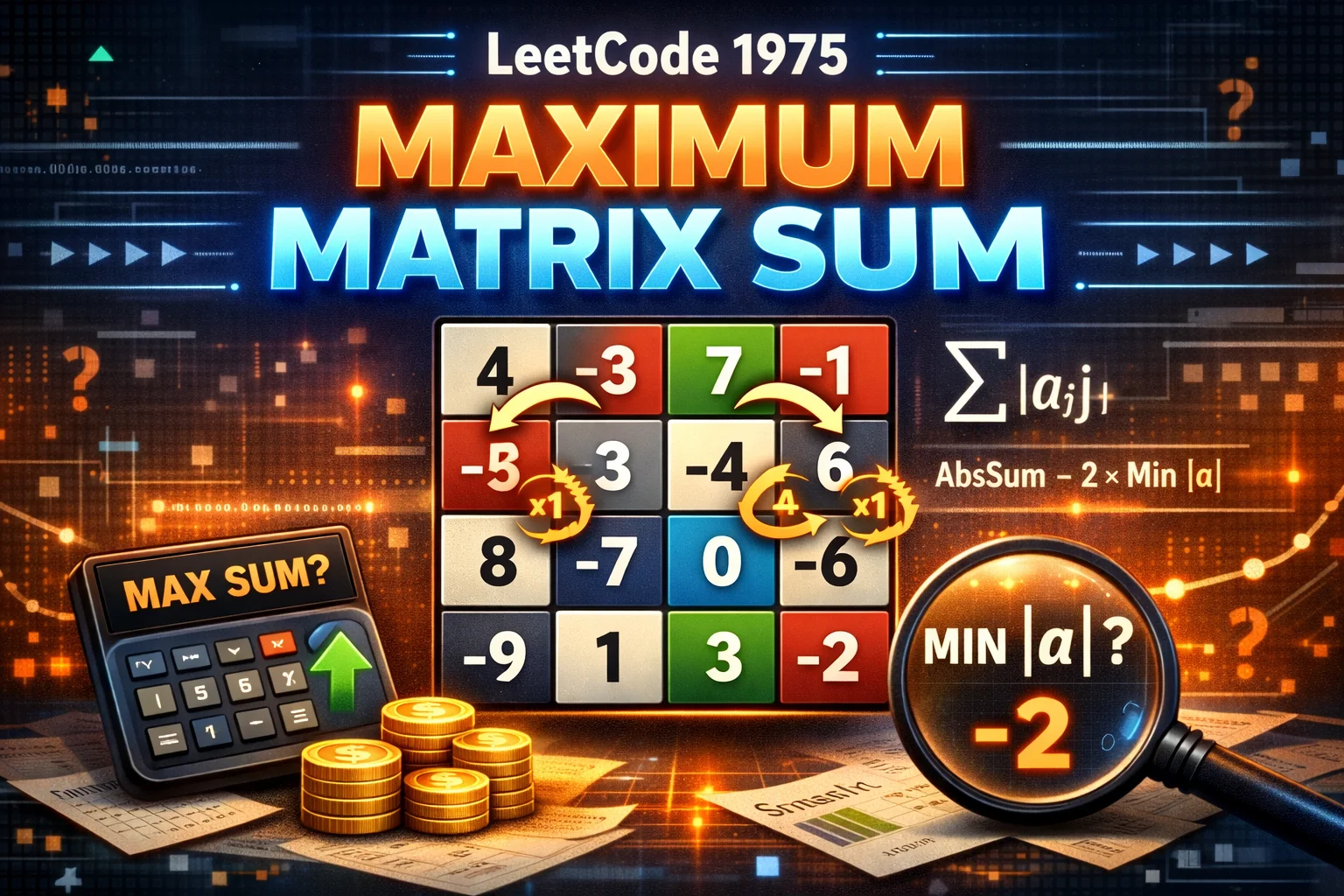
Problem (rephrased)
You’re given an n x n integer matrix. You may perform the following operation any number of times:
- Pick two adjacent cells (share an edge) and multiply both values by
-1.
Your goal is to maximize the sum of all elements in the matrix.
Key Insight
The operation flips the signs of exactly two adjacent cells.
So, ignoring zeros for a moment:
- Flipping two numbers changes the count of negative numbers by an even amount (0, 2, or -2).
- Therefore, the parity (odd/even) of the number of negative elements is an invariant: it does not change.
Why adjacency doesn’t really restrict us
Even though you can only flip adjacent pairs, the grid is connected. Using a path of adjacent flips, you can effectively “transport” a sign flip across the matrix.
A common way to see it:
- Consider any path between two cells
AandB. - If you apply the operation along each edge on the path (in order), every internal cell gets flipped twice (cancels out), while only endpoints get flipped once.
- Net effect: you can flip the signs of any two cells you want, while leaving all others unchanged.
✅ Result: The only real global restriction is parity of negatives (unless there’s a zero, discussed next).
What’s the best possible sum?
Step 1: “Ideal world” — make everything positive
If you could choose signs freely, you’d turn every element into |a[i][j]|, giving: absSum=∑∣aij∣\text{absSum} = \sum |a_{ij}|absSum=∑∣aij∣
That’s the maximum possible sum of magnitudes.
Step 2: Parity constraint decides if you can reach that ideal
Case A: Number of negatives is even
You can pair up negatives and flip them away (conceptually), so you can make all values non-negative.
✅ Answer = absSum
Case B: Number of negatives is odd
If there is no zero, parity cannot change, meaning:
- You cannot make all numbers positive.
- You must leave exactly one number negative.
To maximize the final sum, the negative one should hurt as little as possible → choose the element with the smallest absolute value.
If minAbs = min |a[i][j]|, then leaving -minAbs instead of +minAbs reduces the total by 2 * minAbs: answer=absSum−2⋅minAbs\text{answer} = \text{absSum} – 2 \cdot \text{minAbs}answer=absSum−2⋅minAbs
Case C: There is at least one zero
A zero is special because flipping it doesn’t change it:
0 * (-1) = 0
So if a zero is adjacent (or can be made adjacent through sequences), you can use it to flip the sign of a single element without “paying” a second sign flip effectively affecting parity in the negative-count sense.
Practical takeaway:
- If there is a
0, you can always achieve the “all non-negative” configuration.
✅ Answer = absSum
Final Formula
Compute:
absSum = Σ |a[i][j]|negCount = number of elements < 0minAbs = minimum |a[i][j]|hasZero = any element == 0
Then:
- If
negCountis even orhasZerois true →absSum - Else →
absSum - 2 * minAbs
Algorithm
- Initialize:
absSum = 0negCount = 0minAbs = +∞hasZero = false
- For each value
xin the matrix:absSum += abs(x)- if
x < 0:negCount++ - if
x == 0:hasZero = true minAbs = min(minAbs, abs(x))
- Apply the rule above and return.
Complexity
- Time:
O(n^2)(one pass through the matrix) - Space:
O(1) - Use 64-bit integer (
long long/long/ Python int) because sums can be large.
Python Implementation
class Solution:
    def maxMatrixSum(self, matrix):
        abs_sum = 0
        neg_count = 0
        min_abs = float("inf")
        has_zero = False

        for row in matrix:
            for x in row:
                if x < 0:
                    neg_count += 1
                if x == 0:
                    has_zero = True

                ax = abs(x)
                abs_sum += ax
                min_abs = min(min_abs, ax)

        if has_zero or neg_count % 2 == 0:
            return abs_sum
        return abs_sum - 2 * min_abs
Common Pitfalls
- Forgetting zeros: With a zero present, odd negative parity no longer blocks you from reaching
absSum. - Using 32-bit integers: The sum of absolute values can overflow in languages like C++/Java if you use
int. - Overthinking adjacency: You don’t need to simulate operations; the parity + min-abs logic is enough.