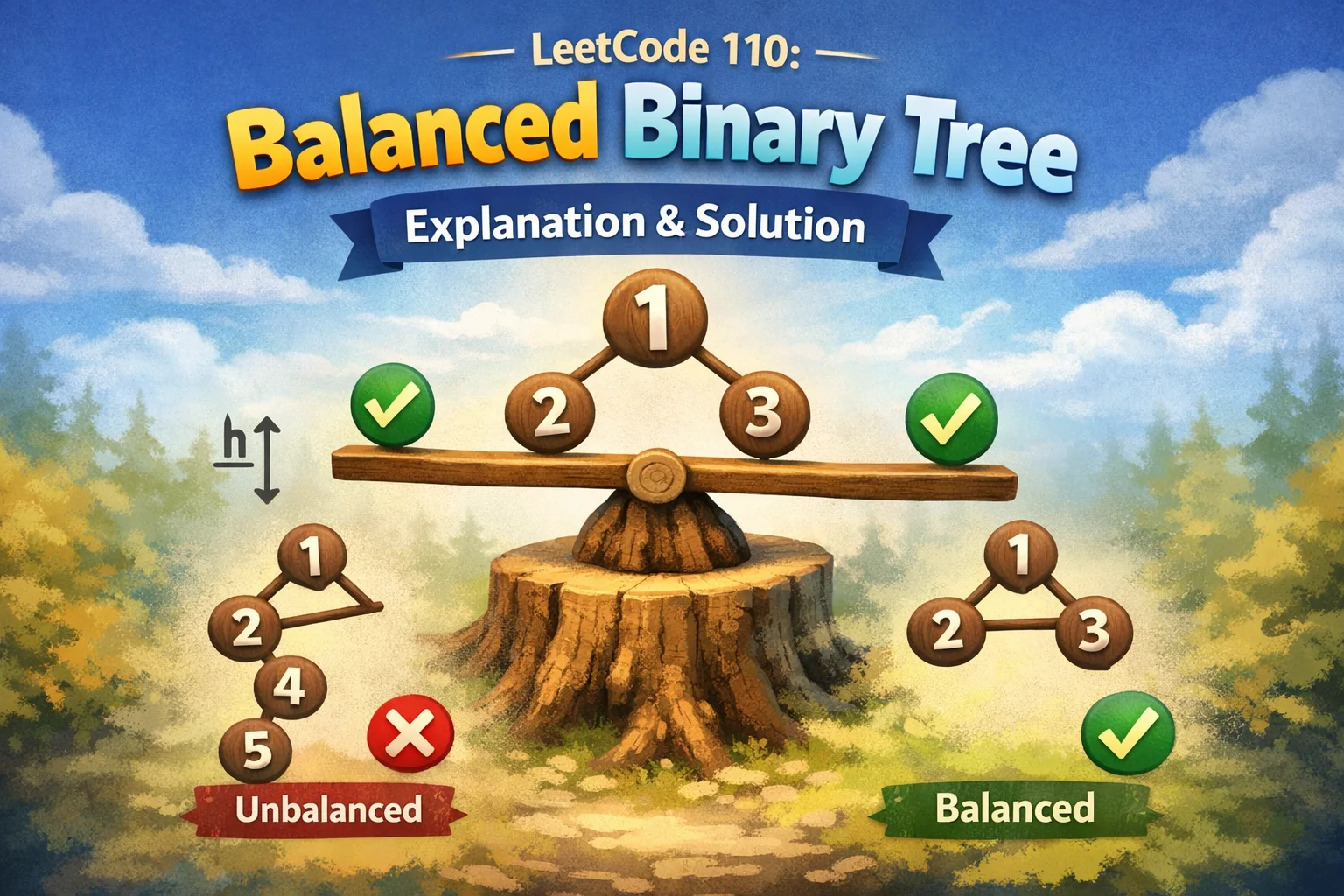
Problem statement
Given the root of a binary tree, determine whether it is height-balanced.
A binary tree is balanced if for every node:
- the height of the left subtree and right subtree differ by at most 1.
Formally, for each node:∣height(left)−height(right)∣≤1
If this condition holds for all nodes, return true, otherwise return false.
Why this problem is tricky
Many people correctly check the height difference at the root, but the real rule says:
✅ Every node must satisfy the condition, not just the root.
So we must verify balance throughout the entire tree.
Key concepts
Height of a tree
Height is the number of nodes (or edges, depending on definition) on the longest path from a node down to a leaf.
Common coding definition used here:
height(null) = 0height(node) = 1 + max(height(left), height(right))
Approach 1 (Naive): Check balance + compute height separately
A straightforward method:
- For each node:
- compute
height(left) - compute
height(right) - check if difference ≤ 1
- compute
- recursively check left and right subtrees too
Problem with this approach
Computing height() for every node repeats a lot of work.
In the worst case (skewed tree), complexity becomes:
- O(n²)
Approach 2 (Optimized): Bottom-up DFS (Postorder) with early stopping
This is the standard best solution.
Core idea
Instead of computing heights again and again, we compute height once per node, while also detecting imbalance immediately.
We do a postorder traversal (left → right → node), because we need subtree heights before checking the current node.
Trick: Use a sentinel value
Return:
- the height if subtree is balanced
-1if subtree is unbalanced
Then:
- if any child returns
-1, immediately return-1 - if
abs(leftHeight - rightHeight) > 1, return-1 - otherwise return
1 + max(leftHeight, rightHeight)
At the end:
- if result is
-1→ not balanced - else → balanced
Step-by-step logic
For each node:
- Compute left subtree height
- Compute right subtree height
- If either is unbalanced → return
-1 - If height difference > 1 → return
-1 - Else return current height
This guarantees:
- every node checked exactly once
- imbalance propagates upward efficiently
Time and space complexity
Time
Each node is visited once:
- O(n)
Space
Recursion stack depth = tree height:
- O(h)
Worst case:O(n)(skewed)
Best/average:O(log n)(balanced tree)
Python solution (clean + interview-ready)
# Definition for a binary tree node.
# class TreeNode:
#     def __init__(self, val=0, left=None, right=None):
#         self.val = val
#         self.left = left
#         self.right = right

class Solution:
    def isBalanced(self, root):
        def height(node):
            if not node:
                return 0

            left_h = height(node.left)
            if left_h == -1:
                return -1  # left subtree already unbalanced

            right_h = height(node.right)
            if right_h == -1:
                return -1  # right subtree already unbalanced

            if abs(left_h - right_h) > 1:
                return -1  # current node is unbalanced

            return 1 + max(left_h, right_h)

        return height(root) != -1
Python Alternative code solution
# Definition for a binary tree node.
# class TreeNode:
#     def __init__(self, val=0, left=None, right=None):
#         self.val = val
#         self.left = left
#         self.right = right
class Solution:
    def isBalanced(self, root: Optional[TreeNode]) -> bool:
        def checkTreeBalance(root):
            if not root:
                return 0,True
            if not root.left and not root.right:
                return 1,True
            leftH=0
            rightH=0
            isBalancedL=True
            isBalancedR=True
            if root.left:
                leftH,isBalancedL = checkTreeBalance(root.left)
            if root.right:
                rightH,isBalancedR = checkTreeBalance(root.right)
            return max(leftH,rightH)+1,(isBalancedL and isBalancedR) and abs(leftH-rightH)<=1
        height,isBalanced = checkTreeBalance(root)
        return isBalanced
C++ solution
class Solution {
public:
    int height(TreeNode* root) {
        if (!root) return 0;

        int left = height(root->left);
        if (left == -1) return -1;

        int right = height(root->right);
        if (right == -1) return -1;

        if (abs(left - right) > 1) return -1;

        return 1 + max(left, right);
    }

    bool isBalanced(TreeNode* root) {
        return height(root) != -1;
    }
};
Java solution
class Solution {
    private int height(TreeNode root) {
        if (root == null) return 0;

        int left = height(root.left);
        if (left == -1) return -1;

        int right = height(root.right);
        if (right == -1) return -1;

        if (Math.abs(left - right) > 1) return -1;

        return 1 + Math.max(left, right);
    }

    public boolean isBalanced(TreeNode root) {
        return height(root) != -1;
    }
}
Quick example walkthrough
Consider:
      1
     / \
    2   3
   /
  4
- Node 4: left=0 right=0 → height=1
- Node 2: left=1 right=0 → diff=1 → height=2
- Node 3: height=1
- Node 1: left=2 right=1 → diff=1 → balanced ✅
Now if we add another node under 4:
      1
     / \
    2   3
   /
  4
 /
5
- Node 5 height=1
- Node 4: left=1 right=0 → height=2
- Node 2: left=2 right=0 → diff=2 ❌ → return -1 and stop early
Common mistakes to avoid
- Checking balance only at the root (must check every node)
- Using separate height calls causing O(n²)
- Forgetting base case
null -> height 0